




David Roberts, Egypt, and Me
Almost a year ago, I promised readers of my newsletter, that I would write a blog post about Scottish-born artist David Roberts (1796-1864), whose work played a small role in my doctoral dissertation and provided many of the images of ancient Egypt in my head. I had forgotten all about that promise until I recently had reason to read back through earlier newsletters. (What can I say? it’s been a busy and difficult twelve months.)
Here we go:
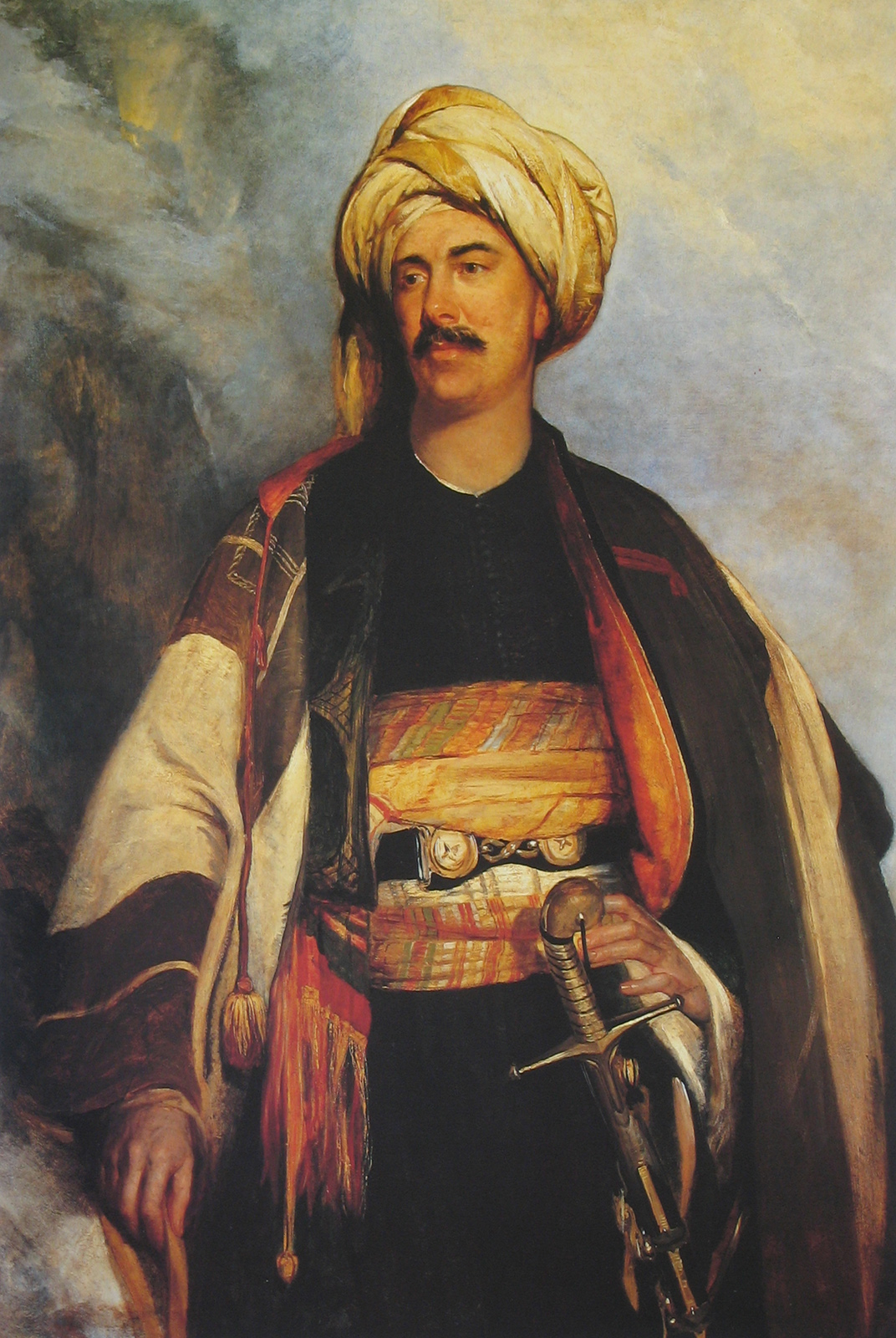
David Robert, painted by Robert Scott Lauder. 1840
David Roberts was a prominent Orientalist painter during his lifetime: one of those artists who was well-known in his time, but is relatively unknown today. Even as a tourist in Egypt, you will see prints of his work everywhere but won’t necessarily learn anything about him.
Here’s the version I would give you if you asked me about Roberts in a public question-and-answer session, or at a dinner party:[1]
Roberts was one of the most celebrated painters and travelers of his generation and a member of the Royal Academy. He is best known for his illustrated travelogue The Holy Land, Syria, Idumea, Arabia, Egypt, and Nubia.
That’s all true, but it leaves out the unusual path that led him to the Middle East and fame. Here’s the longer version:
The son of a shoemaker, Roberts began his artistic career in his hometown of Edinburgh as an apprentice to a house painter and decorator—a trade that included creating elaborate stenciling, trompe l’oeil effects, and faux wood grain and marble. After a seven-year apprenticeship, he took a job as foreman for the redecoration of Scone Palace in Perth. It was a respectable living, but Roberts had artistic aspirations and began to study art in the evenings.[2]
In 1816, Roberts began working as a scene painter and set designer (and occasional straight man for the clown acts) for James Bannister’s traveling circus. His work for Bannister ultimately led to work in theaters in Edinburgh and then London, where he moved in the early 1820s.
In the 1820s, while he continued to make a successful living as a scene painter, Roberts began to devote himself to oil painting, with an emphasis on landscapes. (Personally, I think his time working as a scene painter influenced his later paintings and drawings.) He first exhibited his paintings at the Fine Arts Institute in Edinburgh in 1821. In 1826, he hit the big time with a painting in the annual Royal Academy exhibit. By 1829, he was a full time artist.
Roberts’ early works depicted picturesque scenes from the Scottish and British countryside, or images inspired by books of engravings. But like other painters of picturesque topography , Roberts soon traveled in search of topics for his work. Unlike other painters, he traveled independently, without the support of a wealthy patron or a commission from a publisher for one of the illustrated travel books that were gaining popularity at the time.[3]
In 1832, Roberts traveled to Spain and Morocco—his first trip outside Britain. He returned with a portfolio of sketches that he turned into paintings and illustrations, tapped into the growing European and American interest in travel, armchair and otherwise, to what they thought of as “exotic” places.[4] In 1837, he took his first step into the world of travel books with a popular selection of lithographs titled Picturesque Sketches in Spain.
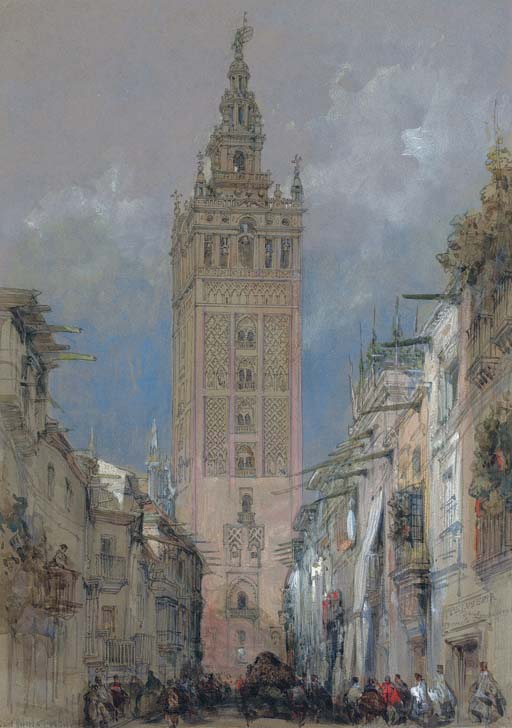
Moorish Tower at Seville.1833
In 1838, Roberts set off a nine-month-long trip through Egypt, Nubia, Sinai, Jordan, Lebanon, and the Holy Land. It was a defining moment in his career. He returned with what he described as “One of the richest folios that ever left the East.” Building on the style he had developed in his Spanish works, he created a distinctive style in which he set scenes of contemporary life in the Middle East against carefully delineated images of ancient monuments, Islamic mosques, and harsh landscapes.
The oil paintings based on sketches from his trip received critical acclaim, but his most influential work was the travel book he created, which was illustrated with 247 hand-colored and tinted large scale lithographs, produced in collaboration with Belgian-born lithographer Louis Haghe (1806-1885). The prints were published in a series of monthly parts between 1842 and 1849. As was generally the case with expensive and uncertain publishing ventures, the portfolios were sold by subscription. Queen Victoria was the first subscriber, a fact which undoubtedly helped the publisher’s marketing effort. (Her complete set is still in the Royal Collection.)
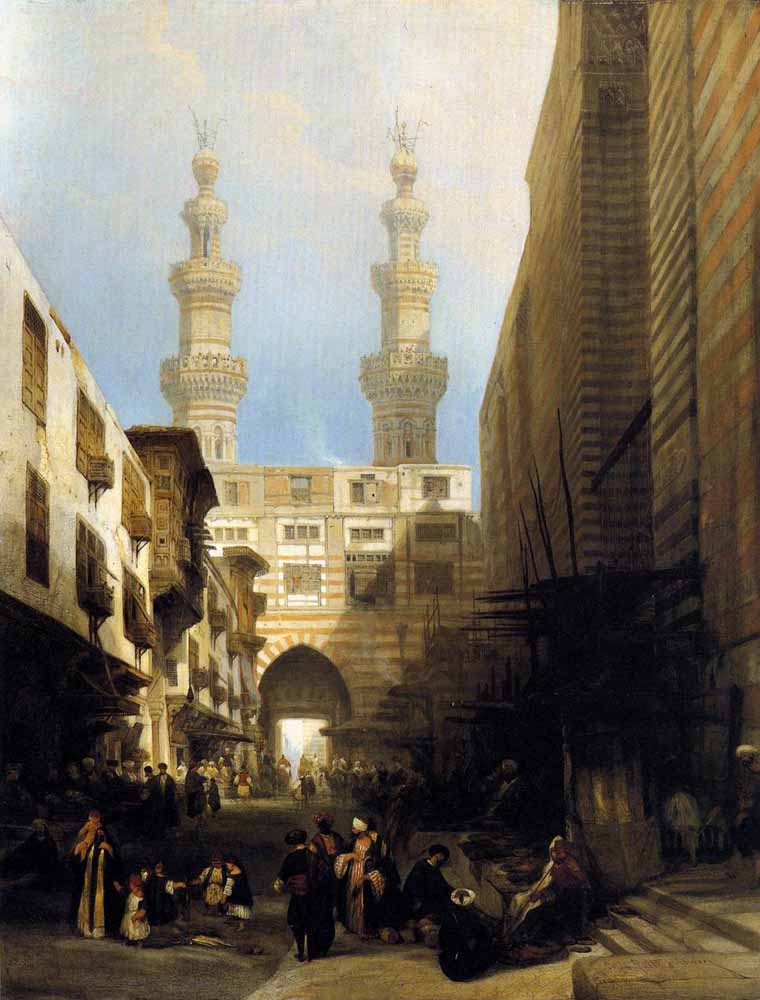
A View in Cairo. 1840
Roberts visited Italy in 1851 and 1853. His last volume of illustrations, Italy, Classical, Historical and Picturesque, was published in 1859.
He spent the last years of his life on a series of views of London from the Thames. He had completed six of the series at the time of his death in 1864.
[1] Or at least I like to think I would show this type of restraint. Actually, as any of you who know me in real life can attest, if someone gives me an opening in company I’m comfortable with I’m apt to lean forward let fly my history nerd flag Iuntil I notice what I’m doing. Then I will shut up and apologize.
[2] Self-improvement was an important part of working class culture in Britain, and especially in Scotland, at this period. A big topic for another time.
[3] Think coffee table books with lithographs instead of photographs.
[4] With full recognition that exotic is a problematic term, with racist and imperialist overtones. Too big a topic to grapple with in a footnote.
All-Night Party
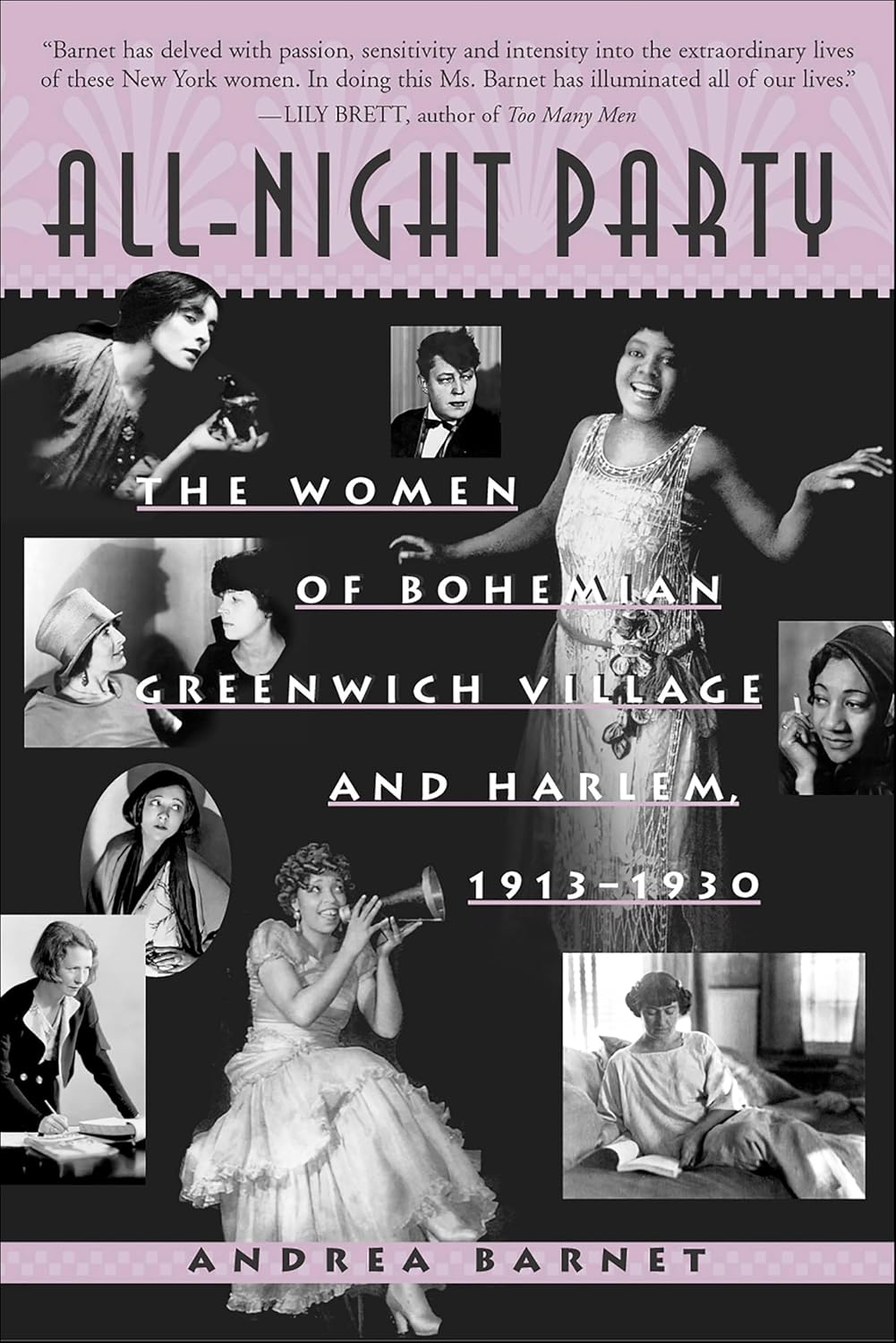
As some of you may have noticed, I’ve been spending a a fair amount of time in recent months in New York City in the 1910s and 1920s, especially the corners of it dedicated to artists, bohemians, and modernists, self-declared and otherwise. Consequently, when All-Night Party: The Women of Bohemian Greenwich Village and Harlem, 1913-1930 by Andrea Barnett crossed my path, I immediately snapped it up.
I expected it to be a companion to Hotbed, Joanna Scutts’ account of radical women in Greenwich Village during much the same period. And in many ways, it is. Barnet discusses many of the women who appear in Hotbed, and makes an occasional passing reference to Heterodoxy, the social club that stands at the center of Scutt’s account. But where Scutts focuses on the radical activism of the women she discusses, using their personal lives as means of entry to the larger social story, Barnet’s account is driven by what she describes as “Creative dissent, whether expressed as artistic innovation or as liberating lifestyle.” Where Scutts’ radical women were for the most part white, with one or two carefully noted exceptions, Barnet divides her subjects evenly between Greenwich Village and Harlem, and the often uncomfortable intersection between the two.
That said, Barnet’s careful attempt at looking at both the white bohemians of Greenwich Village and their Black counterparts in Harlem underlines the fundamental differences between the two worlds. The white women whose stories she tells include poets, artists, magazine publishers, activists, journalists, a photographer, the dancer Isadora Duncan, and at least one woman who seems to have been famous for being famous. With one exception, the Black women she discusses are blues singers. The only place at which their experiences overlap is at the level of the wealthy salon hostesses Mabel Dodge and A’Leila Walker—and the contrast between the two is striking.
I have mixed feelings about All-Night Party, though that may say more about me than it does about the book. I could easily imagine myself as part of the world Scutts depicts in Hotbed; the lives Barnet shares seemed totally alien, even when there is considerable overlap between the two sets of characters. Nonetheless, reading the two in conjunction gave me a richer picture of a complex and fascinating time and place than either book would have provided alone.
Worth the time if you are interested in the period.
From the Archives: Daughters of Chivalry
I’m getting closer to having enough bandwidth to write new posts, honest. In the meantime, here’s one of my favorites from 2019.
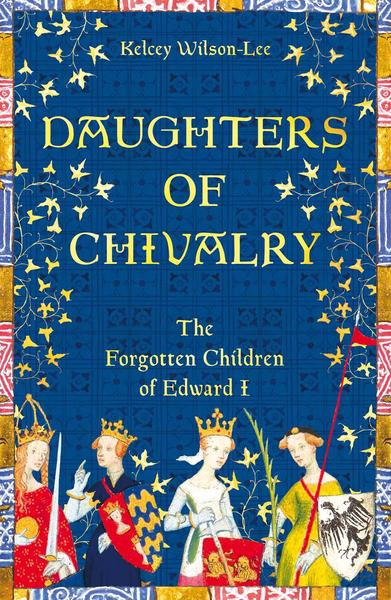
In Daughters of Chivalry: The Forgotten Princesses of King Edward Longshanks, historian Kelcey Wilson-Lee tells the stories of the five daughters of Edward I of England and his first wife, Eleanor of Castile, who survived into adulthood: Eleanora, Joanna, Margaret, Mary, and Elizabeth.
I’ve got to say the book has a shaky start. Wilson-Lee sets up a questionable and unnecessary straw woman in her introduction: a “popular” vision of medieval princesses as powerless and passive that she describes as built on “an empire of fairy stories, Hollywood films, theme parks and cheaply produced ball gowns.” Personally, I’m not sure anyone believes in the powerless princesses she describes–not the little girls who wear those ball gowns with attitude* and certainly not anyone who would chose to read a book titled Daughters of Chivalry. Maybe that version of princesses existed once upon a time, but my own memory of fairy tales includes a fair number of princesses who used every ounce of power they held to control who they married–something only one of the real-life medieval princesses in Daughters of Chivalry managed to control.
That quibble aside, Daughters of Chivalry is an excellent book.
Like even the most elite medieval women, Wilson-Lee’s princesses left a spotty trail in the historical record, most often appearing in official chronicles in the context of their relationship with one of the men in their lives. She fleshes out the picture of their lives using a variety of sources—most notably the account records for the various royal households**—plus a certain amount of informed speculation.
Wilson-Lee uses her sources to good effect. She creates portraits of five clearly defined individuals. Joanna, for instance, frequently defied her father and took full advantage of the opportunities accorded to a young, wealthy widow in medieval society. Mary, who entered the convent of Amesbury at the age of six, had a taste for luxury and a gambling habit at odds with her vow of poverty. She also places the sisters within the larger context of royal women in the late medieval period, exploring questions of education, marriages (political and otherwise), widowhood, property, travel, and the role of royal women as political intercessors. Like the women she describes, Wilson-Lee never loses sight of the fact that what power these women enjoyed was derived from their relationship to the king, but she fully explores the nature of that power and how they used it.
*A year or two ago, I saw a little girl stomping through the aisles of my local grocery store wearing hiking books with a princess gown and carrying a sword. I’m pretty sure she didn’t share Wilson-Lee’s “popular” vision of princesses.
**The nature of her sources means there is a lot of description of real-life princess dresses. This is not a complaint. Just an observation.
Back in March, I celebrated Women’s History Month here in the Margins with a series of mini-interviews with people who are involved in creating and studying women’s history. A lot of you seemed to enjoy it. (I know I did.) So I’m thinking about doing it again in 2020. If there is someone you think would be a good fit, let me know.